
Justice Complex Release Records
The Haywood County Justice Complex houses local court functions at the same South Dupree location used by the sheriff. It does not confine or release people as a second jail. Instead, its case records preserve the legal events that can authorize, explain, delay, or reverse a release. Those events include bond, recognizance, dismissal, acquittal, sentencing, probation, split confinement, jail credit, revocation, and other filed orders.
A court event should not be converted into an exact jail exit time. A bond may be approved before paperwork and payment are complete. A dismissal may coexist with an unrelated hold. A time-served sentence may require calculation and processing. A revocation can return a person to custody after an earlier community release. The Haywood County Sheriff’s Office holds the operational booking and release record; the correct clerk holds the legal case file.
The Justice Complex explains legal authority for a Haywood release. The sheriff confirms the physical departure time and any transfer.
Search Haywood Release Cases
Begin with the official Haywood criminal and court information portal. Search options depend on the live portal, but the research identifies court and case-type selection plus party or case criteria. Use full name, approximate filing or arrest date, and known case number. Compare the charge, counsel, dates, and docket events before accepting a match.
- Select the court and case type most likely to hold the matter.
- Enter the person or case details shown by the portal. Avoid treating one common name as conclusive.
- Read the docket in sequence. Look for bond, dismissal, judgment, sentence, probation, jail credit, revocation, and appeal entries.
- Obtain the filed order from the proper clerk when the online event text is abbreviated.
- Call the Haywood County Jail at 731-772-6158 for the actual departure time, disposition, and transfer destination.
A felony can begin in General Sessions and continue in Circuit Criminal, sometimes under a different trail. Search both when the case history supports it. Appeals and later proceedings may also create entries that should not be mistaken for the original release event.
Haywood Court Record Meanings
Case terms answer different questions. Reading them precisely avoids overstating what the Justice Complex record proves.
| Court event | Release relevance | What still needs confirmation |
|---|---|---|
| Bond or recognizance | Allows pretrial release under stated terms | Whether terms were met and when the jail released the person |
| Dismissal or nolle prosequi | Ends the charge or prosecution named | Other cases, warrants, or holds |
| Acquittal | Not-guilty result after trial | Physical processing and unrelated custody |
| Time served or jail credit | Applies time already confined to a sentence | Calculation, other sentences, and exit time |
| Probation or split confinement | Creates a community-supervision term | TDOC or court supervision and reporting instructions |
| Revocation | May return a supervised person to custody | Warrant execution and current custodian |
| Appeal or amended judgment | May alter the legal posture or sentence | Effect on the active custody record |
“Disposition” means the recorded outcome of a charge or case. “Remand” means a person or case is sent back to custody or a lower tribunal as ordered. Neither word should be given a broader meaning than the filed order supplies.
Confirm Physical Haywood Releases
The Justice Complex docket should be paired with the Haywood County Jail record whenever exact release matters. Call the sheriff’s office and ask whether the person physically left, on what date and time, under which disposition, and whether another agency accepted custody. If a verbal answer does not resolve the issue, request the existing booking sheet, release record, bond or release document, release-log entry, and transfer record.
The Haywood sheriff public-records policy allows oral or written inspection requests and calls for written requests when copies are sought. A focused description should identify the person and approximate booking, then request admission and release timestamps, release authority, bond, holds, and receiving agency. Inspection is generally free; copy and labor costs can apply. Ask for an estimate because the adopted policy contains model-language ambiguities.
When the county booking closes on transfer to TDOC, another county, a federal authority, or ICE, the receiving agency supplies the next custody record. A transfer is not community release. Keep the sheriff’s transfer entry with the court order so that the complete path remains clear.
Justice Complex Clerk Routing
The proper clerk depends on the court and case. The Tennessee Administrative Office of the Courts directory and its clerk finder are the safer routing tools. Research lists the Court Clerk’s Office for Circuit, General Sessions, and Juvenile Courts at the Justice Complex, with a public terminal in the clerk lobby. The office is listed at 100 South Dupree Avenue, 731-772-1112, fax 731-772-8139, Monday through Friday from 8:00 a.m. to 4:30 p.m.
The AOC identifies Felicia Bond as Chancery Clerk and Master at the shared complex, but a criminal request should not be sent there merely because the address matches. Verify whether Circuit Criminal or General Sessions holds the file. Juvenile information has separate confidentiality rules, including restrictions on booking photos absent a court order under TCA § 37-1-155.
Haywood County Justice Complex
100 South Dupree Street
Brownsville, TN 38012
Circuit, General Sessions, and Juvenile clerk line: 731-772-1112
Listed clerk hours: Monday-Friday, 8:00 a.m.-4:30 p.m.
Confirm the correct court before requesting a criminal file.
Correct Haywood Release Records
The shared Justice Complex location makes a mistaken timeline a two-custodian problem. Ask the sheriff to correct a booking, release, transfer, or custody record. Ask the proper clerk or court to address a docket entry, filed order, judgment, sentence, or jail-credit issue. Supply the source document that supports the requested change. A correction in one system does not automatically update the other.
TDOC is a separate custodian for state felony records. If FOIL displays a status, sentence, location, or release detail that conflicts with the filed Haywood judgment, contact TDOC and the originating clerk. An “inactive” state status is not a self-defining release reason. A release certificate, sentence history, or archived TDOC record may be needed to explain the change.
Sealing and expungement can also change what is publicly visible. TCA § 40-32-101 controls Tennessee expungement eligibility and procedure. Release alone does not create eligibility. When a signed order covers the record, the clerk and agencies follow the order within its statutory scope. A vanished search result without an order may instead reflect delay, spelling, indexing, or the wrong court.
Haywood Supervision Court Records
A probation order from the Haywood court file can explain why a person left jail and entered community supervision. Probation is court ordered. Parole is decided by the Tennessee Board of Parole for a state sentence and is supervised by TDOC Community Supervision. They should not be used as synonyms. Split confinement combines custody with a probation period, while a revocation can change community status back to custody.
For a covered state case, TDOC FOIL may show probation, parole, incarcerated, or inactive status plus sentence and release information. Compare it to the filed court order. The Haywood County probation and parole page explains District 60, the Jackson field office, Board actions, and discharge records. Individual reporting instructions control where a supervised person must appear.
VINE can provide a custody-event notice but is not a court docket or full supervision case file. It should not replace a discharge certificate, probation order, or Board record. If a violation or warrant is alleged, verify it with the responsible court and supervising agency.
About the Justice Complex
The Haywood County Justice Complex is included among local release-record locations because its records remain useful after a short-lived custody entry disappears. It is not a detention facility. It does not operate a jail roster, release list, or offender locator. Its role is judicial: preserving case events and filed documents that give legal context to a release, continued hold, supervision term, or return to custody.
The image below comes from the official Tennessee clerk directory and helps identify the proper record custodian.
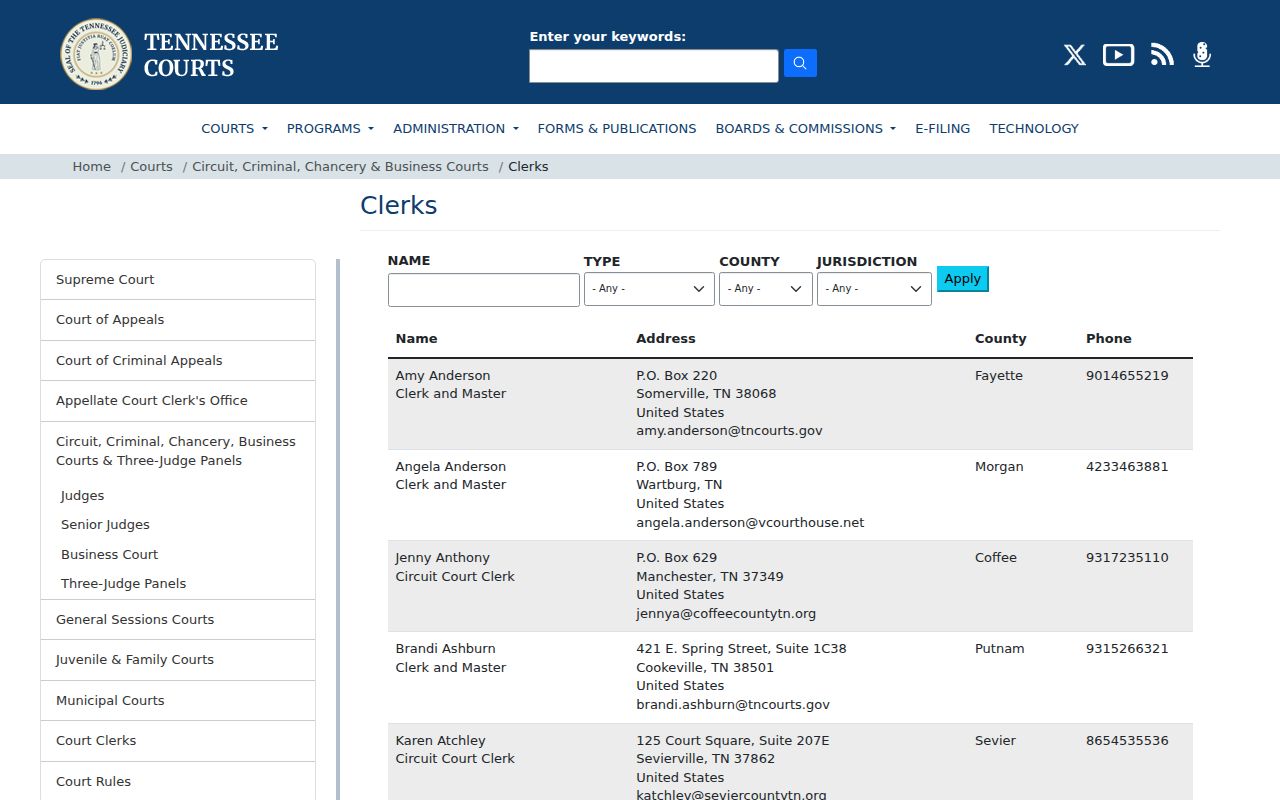
The directory route matters because several court functions share the location, while the sheriff, clerk, and TDOC retain different parts of the release timeline.
The Haywood County released inmate lookup compares the sheriff, court, FOIL, VINE, BOP, and ICE channels. Use it when the Justice Complex case points to a transfer or another supervision system. For a local physical departure, continue to Haywood County Jail release records.
Note: A Justice Complex docket can explain release authority, but only the custodial agency can certify the actual departure or transfer.